
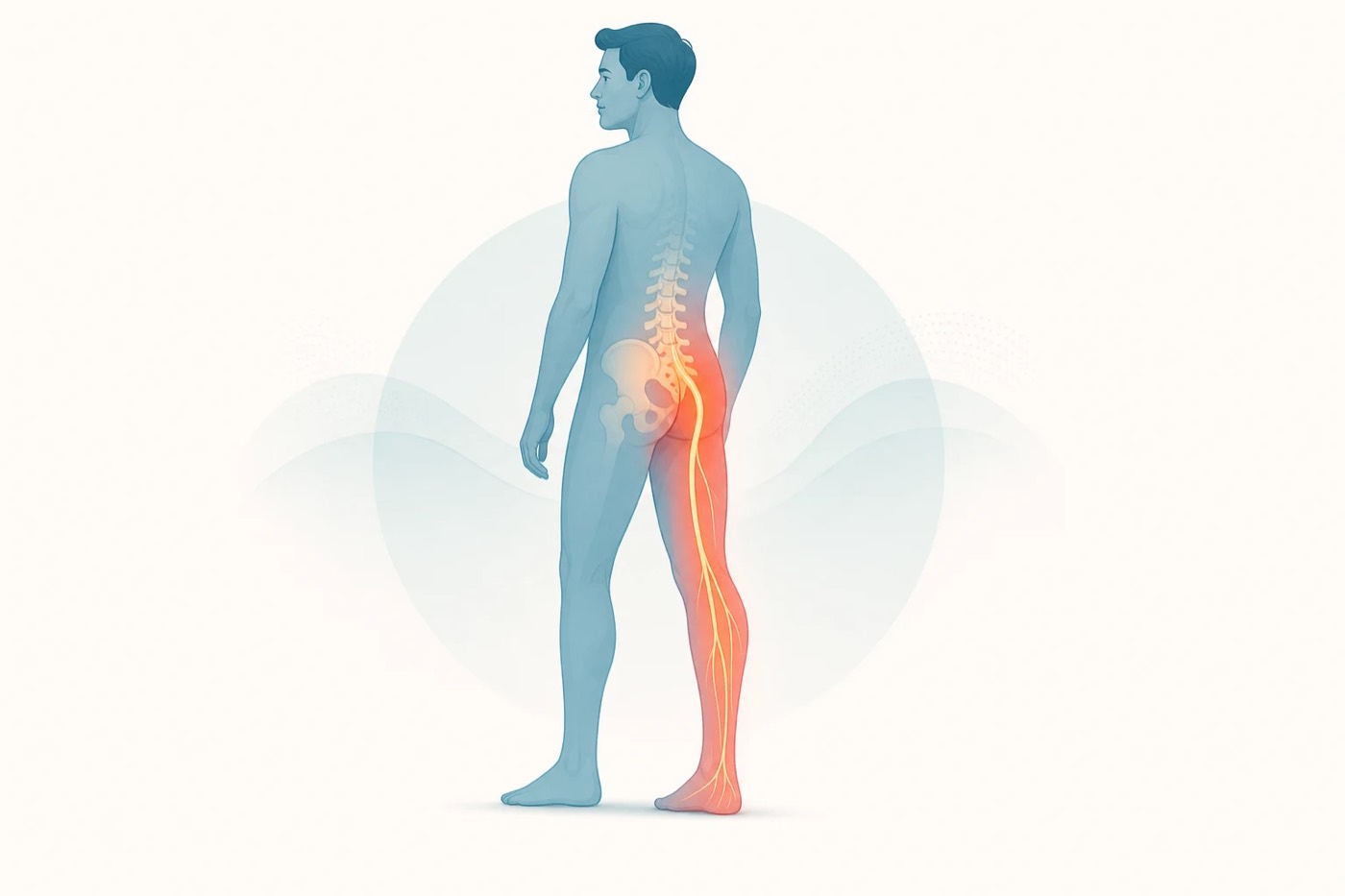
Sciatica is one of the most common — and most misunderstood — pain conditions we treat at APARC Health & Motion. Across our centres in Rohini, Dwarka, Pitampura, and throughout Delhi NCR, sciatica accounts for a significant proportion of new physiotherapy referrals every month. Yet many patients endure months or even years of debilitating pain before seeking help, often because they don't recognise the symptoms or believe rest is the answer.
It isn't. And this guide will explain why — and what you can safely do at home to start managing sciatica pain relief right now.
What Exactly Is Sciatica?
Understanding the Sciatic Nerve
The sciatic nerve is the longest and widest nerve in the human body. It originates from five nerve roots in the lumbar and sacral spine (L4, L5, S1, S2, S3), merges in the lower back, passes through the buttock, and runs down the back of each leg — all the way to the heel and sole of the foot.
When any part of this nerve is compressed, irritated, or inflamed, it produces the characteristic shooting, burning, or electric-shock pain that radiates from the lower back, through the buttock, and down the leg.
It is important to understand that sciatica is a symptom, not a diagnosis. It tells you that the sciatic nerve is irritated — but the cause of that irritation requires proper assessment to identify. The most common causes include:
- Lumbar disc herniation (slipped disc) — the most common cause, where the soft inner material of a disc pushes outward and presses on a nerve root
- Lumbar spinal stenosis — narrowing of the spinal canal that compresses nerve roots, more common in those over 50
- Piriformis syndrome — the piriformis muscle in the buttock irritates or compresses the sciatic nerve
- Spondylolisthesis — one vertebra slipping forward over another, compressing the nerve
- Degenerative disc disease — wear and tear of the spinal discs reducing disc height and causing nerve irritation
Recognising Sciatica: Symptoms to Watch For
Sciatica typically presents with some or all of the following:
- Pain that starts in the lower back or buttock and travels down one leg (occasionally both)
- Pain described as burning, electric-shock, shooting, or stabbing — not just a dull ache
- Numbness or tingling (pins and needles) anywhere along the sciatic nerve path
- Weakness in the leg or foot — difficulty lifting the front of the foot (foot drop) is a red flag
- Pain that worsens with prolonged sitting, especially in car seats
- Pain that is worse when coughing, sneezing, or straining
- One-sided symptoms are more typical — true bilateral sciatica is less common and warrants urgent evaluation
4 Physiotherapy Exercises for Sciatica Pain Relief at Home
These sciatica pain relief exercises are recommended as a starting point for mild-to-moderate symptoms. They are safe for most adults but should be performed gently and within pain-free range. If any exercise significantly increases your leg pain, stop immediately.
Pelvic Tilt
Target: Lower back, core stability, lumbar decompression
How to do it: Lie on your back with knees bent and feet flat on the floor. Gently flatten your lower back against the floor by tightening your abdominal muscles and tilting your pelvis — imagine pressing your belly button towards the floor while slightly tucking your tailbone. Hold for 5–10 seconds. Breathe normally throughout. Slowly release.
This exercise gently activates the deep core muscles that support the lumbar spine, reduces compressive load on the affected disc or nerve root, and is one of the safest starting points for pinched nerve in back management.

The pelvic tilt gently activates the deep lumbar stabilisers without loading the compressed nerve root.
Knee-to-Chest Stretch (Single and Double)
Target: Lumbar decompression, gluteal stretch, nerve root relief
How to do it: Lie on your back. Gently bring one knee towards your chest, holding just below the knee. Hold 30 seconds, feeling gentle decompression in the lower back. Switch sides. Then bring both knees up together — this creates gentle lumbar flexion which can relieve disc-related nerve compression.
Note: For some people, lumbar extension (arching backwards) provides more relief than flexion. If this exercise worsens leg pain, try the McKenzie extension exercise below instead.
McKenzie Press-Up (Prone Extension)
Target: Lumbar extension, disc centralisation, nerve root decompression
How to do it: Lie face down, hands flat beside your shoulders as in a press-up position. Keeping your pelvis on the floor, slowly push your upper body upward, arching your lower back. Go as far as comfortable without forcing. Hold 2–3 seconds at the top, then lower. The goal is to "centralise" your pain — to feel it move from your leg back into your lower back. Centralisation of pain is a positive sign.
McKenzie extension is particularly effective for disc-related sciatica. Many patients notice a significant reduction in leg symptoms within the first few sessions.

Heel slides are gentle enough to perform even during a sciatica flare-up and help maintain hip and knee mobility without stressing the nerve.
Piriformis Stretch
Target: Piriformis muscle, sciatic nerve decompression through the buttock
How to do it: Lie on your back with both knees bent. Cross your right ankle over your left knee (figure-4 position). Gently push your right knee away from you while bringing your left knee slightly towards your chest. You should feel a stretch deep in your right buttock. Hold 30–45 seconds. Switch sides.
This stretch is particularly effective if your sciatica originates from piriformis syndrome rather than a disc issue — you'll know because the buttock pain is often more prominent than the lower back pain.
The Best Sleeping Position for Sciatica
Sleep quality is often severely impacted by sciatica. The best sleeping position for sciatica depends on whether your pain is relieved by flexion or extension — but here are the general recommendations:
✅ Recommended Positions
- On your side (foetal position) with a pillow between your knees — relieves lumbar pressure and keeps the spine aligned
- On your back with a pillow under the knees — reduces lumbar lordosis and decompresses the nerve roots
- On a medium-firm mattress — too soft allows the spine to sag; too firm creates pressure points
❌ Positions to Avoid
- On your stomach — forces the cervical spine into rotation and increases lumbar lordosis
- On your back without support — legs flat increases tension on the sciatic nerve
- Twisted or asymmetric positions — any position where the spine is rotated and held for hours
What to Avoid During a Sciatica Flare-Up
- Prolonged sitting — especially on low, soft chairs or car seats. Use a rolled towel for lumbar support
- Bending and lifting from the waist — always bend the knees and keep the back straight
- High-impact exercise — running, jumping, or heavy gym work during acute symptoms
- Complete bed rest beyond 1–2 days — prolonged rest weakens muscles and actually prolongs recovery
- Ignoring the symptoms — progressive neurological symptoms (increasing weakness or numbness) require urgent assessment
Why Physiotherapy Is the Most Effective Treatment for Sciatica
Research consistently shows that physiotherapy produces better long-term outcomes for sciatica than pain medication or passive rest. Our approach at APARC across Rohini, Dwarka, and Pitampura includes:
- Full neurological and musculoskeletal assessment to identify the exact cause and nerve root involved
- Manual therapy — spinal mobilisation, nerve mobilisation, and soft tissue techniques to reduce neural tension
- McKenzie Method — a specific directional exercise approach proven highly effective for disc-related sciatica
- Core stability training — building the muscular support system around the lumbar spine
- TECAR therapy and Class IV laser — advanced modalities that reduce nerve inflammation and accelerate healing
- Traction therapy — mechanical spinal decompression for severe disc-related cases
Living with Sciatica? You Don't Have To.
Our specialist physiotherapists at APARC centres in Rohini, Dwarka, Pitampura, Janakpuri, Paschim Vihar and across Delhi NCR provide comprehensive assessment and evidence-based treatment for sciatica — with most patients experiencing significant improvement within 4–6 sessions.
📅 Book a Sciatica AssessmentWhen Should You See a Doctor Instead of a Physiotherapist?
In most cases, physiotherapy is the first-line treatment for sciatica. However, see a doctor or seek emergency care if you experience:
- Loss of bladder or bowel function — this is a medical emergency
- Rapidly progressive leg weakness
- Sciatica following a fall, road traffic accident, or direct spinal trauma
- Sciatica combined with unexplained weight loss, night sweats, or fever (may indicate infection or tumour)
- Symptoms that have not improved at all after 6–8 weeks of appropriate physiotherapy
In these cases, investigations including MRI or CT scan may be needed to guide treatment decisions.