
You've twisted your ankle, pulled a hamstring, or landed awkwardly on the football pitch. Pain shoots through the joint, swelling begins almost immediately, and you're not sure whether to push through, rest completely, or rush to a doctor. This is a situation thousands of people across Delhi NCR, Gurugram, Noida, and Pune face every week.
Knowing what to do in the first 24–72 hours after a soft tissue injury can make a significant difference to your recovery time. The RICE method — and its more recent evolution, the PRICE protocol — is the internationally recognised first-aid framework that every athlete, parent, and active person should know.
Sprain vs. Strain: Understanding the Difference
Before applying first aid, it helps to understand what type of injury you're dealing with:
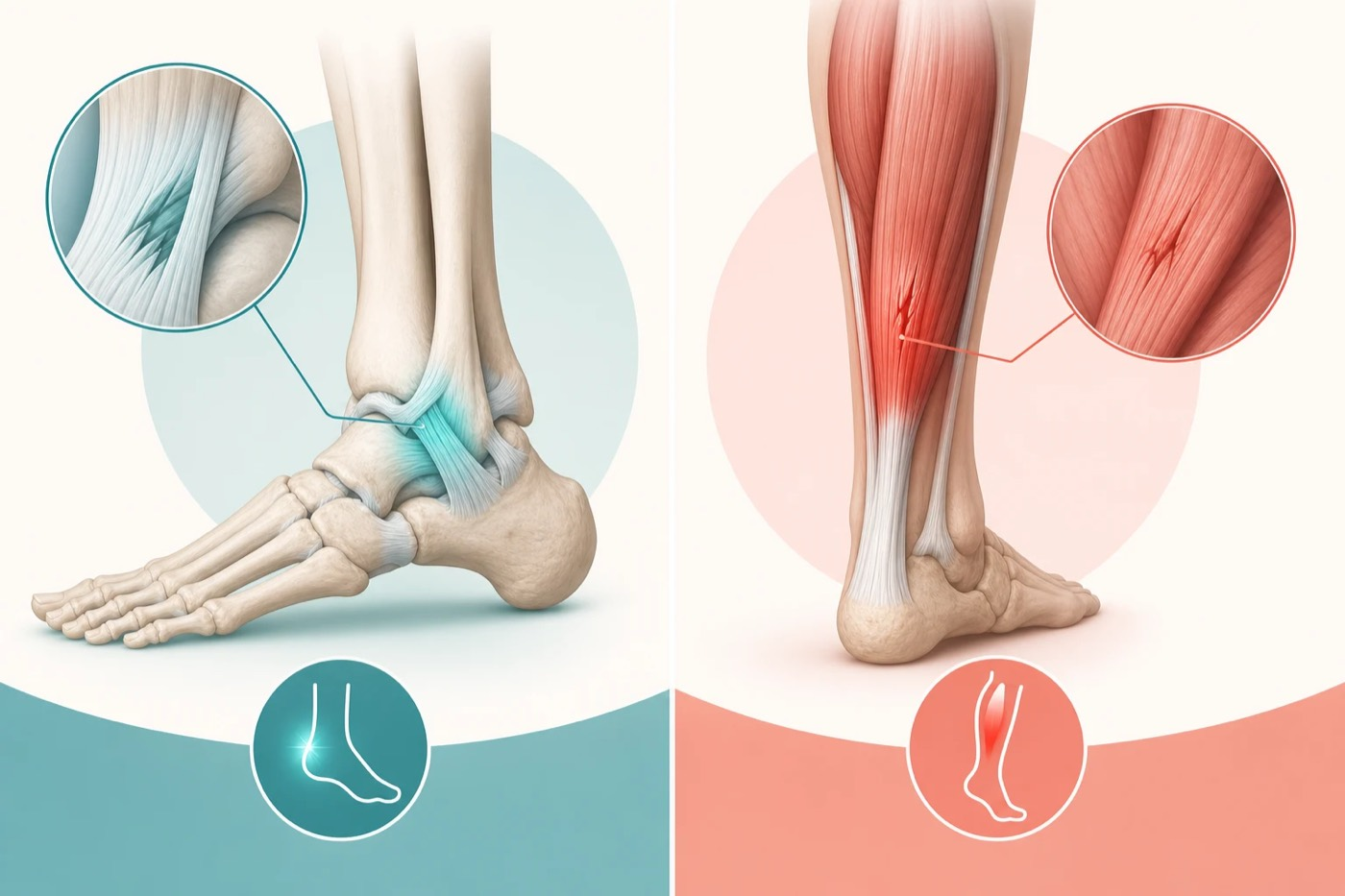
🦴 Sprain
A sprain is an injury to a ligament — the fibrous tissue that connects bone to bone at a joint.
- Occurs at joints: ankle, knee, wrist, thumb
- Caused by excessive joint movement
- Common symptoms: pain, swelling, bruising, instability
💪 Strain
A strain is an injury to a muscle or tendon — the tissue connecting muscle to bone.
- Occurs in muscles: hamstring, calf, lower back, groin
- Caused by overstretching or sudden contraction
- Common symptoms: pain, muscle spasm, weakness, stiffness
Grades of Sprain: How Serious Is It?
Microscopic Tears
Minor stretching of ligament fibres. Mild pain and minimal swelling. Usually recovers in 1–2 weeks.
Partial Tear
Significant ligament damage. Moderate-severe pain, swelling and bruising. Recovery 3–6 weeks with physio.
Complete Rupture
Complete ligament tear. Significant instability, severe pain. May require surgical review. 3–6 months recovery.
The PRICE Protocol: Step-by-Step First Aid for Sprains and Strains
The modern gold standard is the PRICE protocol — an evolution of the classic RICE method that adds Protection as the crucial first step. Here's exactly what to do:
Protection
First 1–3 daysImmediately protect the injured area from further harm. Stop the activity that caused the injury. Use a support bandage, brace, or crutches if needed to avoid loading the injured tissue. This does not mean complete immobilisation — gentle, pain-free movement is encouraged from day one.
Do: Use a walking boot or crutches if the ankle cannot bear weight. Apply a compression bandage before standing.
Don't: Continue playing through pain. Ignore the injury and hope it passes.
Rest
First 48–72 hoursRelative rest — not complete inactivity. Rest means avoiding the specific movements and loads that cause pain. Gentle movement of the unaffected joints and non-painful range of motion exercises can begin almost immediately, which helps reduce swelling and maintain mobility.
For an ankle sprain: rest from walking on uneven ground, but gentle ankle pumps and circles (within pain-free range) can start within hours of injury.

Gentle ankle pumps — pointing and flexing the foot — can begin within hours of an ankle sprain to reduce swelling and maintain mobility.
Ice
20 min on, 20 min off — first 48–72 hoursApply ice or a cold pack (wrapped in a cloth — never directly on skin) to the injured area for 20 minutes at a time, with at least 20 minutes off between applications. Ice reduces pain by numbing the area and helps limit the initial inflammatory response that causes excessive swelling.
Practical tip: A bag of frozen peas wrapped in a damp cloth works perfectly. Keep it in the freezer and use every hour for the first day.
Compression
Continuously for first 48–72 hoursApply a compression bandage (crepe or tubular bandage) firmly — but not tightly — around the injured area. Compression limits swelling by preventing fluid from pooling in the tissue. The bandage should be firm without causing numbness, tingling, or change in skin colour.
How to apply: Start wrapping below the injury and work upward in overlapping figure-of-8 spirals. Check every hour that fingers or toes below the bandage are warm and have normal sensation.
Elevation
As much as possible for first 48–72 hoursRaise the injured limb above heart level whenever possible — especially while sleeping and resting. For an ankle injury, prop your leg on two pillows while lying down. For a wrist, support your arm on cushions while seated. Elevation uses gravity to drain fluid away from the injury and significantly reduces swelling.
Rule of thumb: The injured limb should be above the level of your heart, not just slightly raised.

Professional physiotherapy assessment is recommended for any moderate or severe sprain to ensure proper healing and prevent long-term instability.
What Not to Do: The HARM Principle
Just as important as what you should do is what you should avoid in the first 72 hours after injury. Remember HARM:
- H — Heat: Avoid hot baths, heat packs, or saunas. Heat increases blood flow and will worsen swelling in the acute phase
- A — Alcohol: Alcohol increases swelling and bleeding, and impairs healing. Avoid for at least 48 hours post-injury
- R — Running: Avoid any exercise that loads the injured area until pain and swelling have significantly reduced
- M — Massage: Deep massage in the first 72 hours increases inflammation and can worsen tissue damage. Gentle lymphatic drainage by a trained therapist is acceptable — but deep tissue massage is not
After 72 Hours: When Rehabilitation Begins
PRICE manages the acute phase, but it's only the beginning. After 72 hours — once swelling begins to reduce — the rehabilitation phase starts. This is where physiotherapy becomes essential.
A comprehensive physiotherapy programme for a sprain or strain includes:
- Range of motion exercises — to restore full joint movement
- Strengthening exercises — to rebuild the muscles that support the injured joint
- Proprioception training — balance and coordination exercises that are critical for preventing re-injury
- Manual therapy — joint mobilisation and soft tissue release to address stiffness and scar tissue
- Functional rehabilitation — sport-specific or activity-specific exercises to prepare for return to full activity
When to See a Physiotherapist
You should seek professional assessment for any soft tissue injury that:
- Does not show improvement within 72 hours of PRICE treatment
- Involves significant swelling, bruising, or inability to bear weight
- Is recurring — the same joint has been sprained before
- Is in an athlete who needs a structured return-to-sport programme
- Involves the knee (especially with any sensation of instability or "giving way")
Our physiotherapy teams at APARC Health & Motion — with centres across Delhi NCR, Rohini, Dwarka, Janakpuri, Paschim Vihar, Gurugram, Ghaziabad, Greater Noida, and Pune — provide comprehensive assessment and rehabilitation for all types of soft tissue injuries. We also offer home physiotherapy services for patients who cannot travel to a clinic in the early days after injury.
Injured? Don't Wait for It to "Get Better on Its Own"
A professional physiotherapy assessment ensures your sprain heals correctly, restores full stability, and reduces the risk of re-injury. Book an appointment at any APARC centre near you.
📅 Book a Physiotherapy AssessmentQuick Reference: PRICE Protocol Summary
- ✅ P — Protect: Stop activity, use support if needed
- ✅ R — Rest: Avoid painful movements, allow gentle pain-free motion
- ✅ I — Ice: 20 minutes on / 20 off, for first 48–72 hours
- ✅ C — Compress: Firm bandage, check circulation regularly
- ✅ E — Elevate: Above heart level, especially when resting
- ❌ Avoid HARM: No heat, alcohol, running, or deep massage for 72 hours
- 📞 Seek help: If no improvement in 72 hours, or for any moderate/severe injury