How to Fix Your Posture at Work: A 5-Minute Desk Routine
Suffering from neck pain at work? Learn simple posture correction exercises and desk ergonomics tips in this 5-minute routine. Expert advice from APARC Health & Motion, a physiotherapy network across Delhi NCR.
How to Fix Your Posture at Work: A 5-Minute Desk Routine
By Dr. Meenakshi Rajput, Executive Director, APARC Health & Motion
Do you feel that dull ache in your neck by mid-afternoon? Does your lower back protest after a long day at your desk? Do you catch yourself slouching forward, shoulders rounded, head jutting toward your computer screen?
If you answered yes to any of these questions, you are not alone. In fact, poor posture at work has become so common that healthcare professionals now refer to it as the "sitting disease." At APARC Health & Motion, we treat hundreds of professionals from Delhi, Gurugram, and Noida each year who come to us with chronic neck pain, tension headaches, and lower back problems—all directly linked to how they sit at work.
The good news? You can fix it. And it only takes 5 minutes a day.
In this guide, I'll show you a simple 5-minute desk routine with proven posture correction exercises, essential desk ergonomics tips, and expert advice to keep you pain-free and productive.
Why Your Posture Matters More Than You Think
Before we dive into the exercises, let's understand what happens to your body during hours of desk work.
When you sit with poor posture—shoulders rounded, head forward, lower back slumped—you create a cascade of problems:
- Your head weighs 4-5 kg in neutral position. For every inch it moves forward, the effective weight on your neck doubles. At 2 inches forward, your neck is supporting the equivalent of 15-20 kg.
- Your shoulder muscles shorten and tighten, leading to restricted movement and pain between your shoulder blades.
- Your chest muscles tighten, pulling your shoulders further forward in a vicious cycle.
- Your lower back loses its natural curve, putting pressure on spinal discs and leading to chronic back pain.
- Your breathing becomes shallow because your rib cage can't expand fully, reducing oxygen to your brain and making you feel tired.
The result? Neck pain, tension headaches, fatigue, and eventually more serious conditions like cervical spondylosis, herniated discs, and chronic muscle tension.
At our physiotherapy clinics across Delhi NCR, we see the consequences of poor desk posture every single day. But we also see how quickly people improve once they learn the right exercises and ergonomics.
First: Fix Your Desk Setup (Ergonomics Basics)
Exercises alone won't fix your posture if your workstation is working against you. Before we start the 5-minute routine, take 2 minutes to check your desk setup:
Chair Position
- Your feet should rest flat on the floor (or on a footrest)
- Your knees should be at 90 degrees, level with or slightly lower than your hips
- Your lower back should be supported—use a lumbar roll if your chair lacks support
Desk Height
- Your elbows should be at 90 degrees when typing
- Your wrists should be straight, not bent up or down
- If your desk is too high, raise your chair and use a footrest
Screen Position
- The top of your monitor should be at or slightly below eye level
- Your screen should be an arm's length away
- If you use a laptop, elevate it on a stand and use a separate keyboard and mouse
Phone Use
- Never cradle your phone between your ear and shoulder
- Use a headset, speakerphone, or hold the phone in your hand
For a personalized ergonomics assessment, visit our orthopedic physiotherapy department at any of our centres.
The 5-Minute Desk Routine: 5 Exercises to Fix Your Posture
Perform these exercises right at your desk. Set a reminder to do them once in the morning and once in the afternoon. In just 5 minutes, you'll counteract the damage of sitting and retrain your body toward better posture.
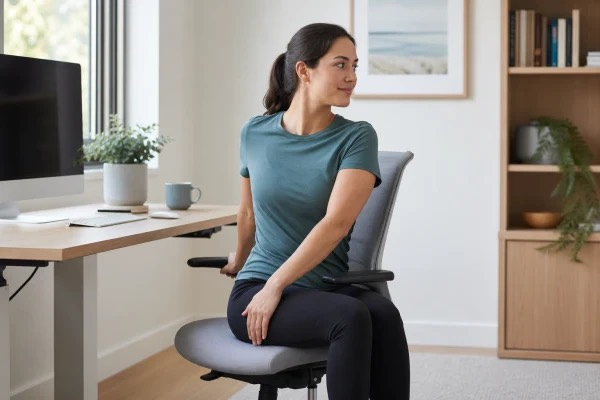
Exercise #1 — Seated Trunk Rotations (Spine Mobility)
This exercise mobilizes your entire spine and relieves the stiffness that builds up from staying in one position too long.
How to do it:
- Sit tall in your chair with your feet flat on the floor
- Place your right hand on your left knee (or the outside of your left thigh)
- Place your left hand behind you on the backrest of your chair or on your left hip
- Slowly rotate your upper body to the left, looking over your left shoulder
- Go only as far as comfortable—you should feel a gentle stretch, not pain
- Hold for 15-20 seconds, breathing deeply
- Slowly return to center and repeat on the right side
- Perform 2-3 rotations on each side
Key Benefits: Improves spinal mobility, relieves mid-back stiffness, counteracts the forward-rotated position of desk work.
Exercise #2 — Chin Tucks (Neck Pain Relief)
This is the single most important exercise for anyone with neck pain from desk work. It strengthens the deep neck flexors and corrects forward head posture.
How to do it:
- Sit tall with your shoulders relaxed
- Look straight ahead
- Without tilting your head down, gently pull your chin straight back—like you're making a "double chin"
- You should feel a gentle stretch at the base of your skull and the back of your neck
- Hold for 5 seconds, then relax
- Repeat 10 times
Pro Tip: Do this exercise every time you check your phone or feel neck tension building. It's invisible—no one will know you're doing it!
Key Benefits: Corrects forward head posture, strengthens deep neck flexors, relieves tension headaches and neck pain.
Exercise #3 — Doorway Chest Stretch (Open Up Tight Chest)
Hours of reaching forward to your keyboard tightens your chest muscles, which pulls your shoulders forward. This stretch reverses that.
How to do it:
- Stand in an open doorway or next to a sturdy vertical surface
- Place your forearm on the door frame at a 90-degree angle, elbow at shoulder height
- Gently lean forward until you feel a stretch across your chest
- Hold for 20-30 seconds
- Repeat on the other side
- For a deeper stretch, raise your arm slightly higher or lower to target different parts of the chest
Key Benefits: Opens tight chest muscles, allows shoulders to return to proper position, improves breathing.
Exercise #4 — Stretching Toward the Sky (Full Body Awakening)
This exercise decompresses your spine and wakes up your entire body after hours of sitting.
How to do it:
- Stand up from your desk
- Interlace your fingers and turn your palms to face the ceiling
- Stretch your arms straight up overhead
- Look up slightly and reach as high as you comfortably can
- Hold for 10-15 seconds while breathing deeply
- On an exhale, fold forward and let your arms hang toward the floor (bend your knees slightly)
- Hang for 10-15 seconds
- Slowly roll up to standing, one vertebra at a time
- Repeat 2-3 times
Key Benefits: Decompresses spine, stretches entire front body, improves circulation, boosts energy.

Exercise #5 — Seated Shoulder Blade Squeezes (Upper Back Strength)
This exercise strengthens the muscles that pull your shoulders back into good posture.
How to do it:
- Sit tall with your arms relaxed at your sides
- Gently squeeze your shoulder blades together and down—imagine trying to hold a pencil between them
- Hold for 5 seconds, feeling the muscles between your shoulder blades engage
- Relax completely
- Repeat 10-15 times
Key Benefits: Strengthens upper back muscles, counteracts rounded shoulders, improves posture endurance.
Your 5-Minute Desk Routine: Quick Reference
| Exercise | Duration/Reps | When to Do It |
|---|---|---|
| Seated Trunk Rotations | 2-3 each side (hold 15-20 sec) | Mid-morning, mid-afternoon |
| Chin Tucks | 10 reps (hold 5 sec each) | Every 1-2 hours |
| Doorway Chest Stretch | 20-30 sec each side | Before lunch, before leaving |
| Stretching Toward the Sky | 2-3 rounds (10-15 sec each) | Any time you feel stiff |
| Shoulder Blade Squeezes | 10-15 reps | Every hour |
Total time: Approximately 5-7 minutes
Additional Tips for Desk Workers
Take Micro-Breaks
Set a timer for every 30-45 minutes. Stand up, walk a few steps, and do 30 seconds of movement. This prevents the "creep" into poor posture that happens when you sit too long.
Hydrate Constantly
Water keeps your spinal discs healthy. Keep a water bottle at your desk and refill it often—the walk to the water cooler is bonus movement!
Consider a Standing Desk
Alternating between sitting and standing throughout the day is ideal. If you don't have a standing desk, improvise by placing your laptop on a high counter for 20-30 minutes at a time.
Stretch Your Hip Flexors
Sitting shortens your hip flexors, which contributes to lower back pain. At least once a day, do a standing hip flexor stretch:
- Step one foot back, keep both feet pointing forward
- Bend your front knee and gently press your hips forward
- Hold for 20-30 seconds, repeat on other side
When to See a Physiotherapist
While this 5-minute routine helps most people, some situations require professional attention. Visit one of our 15+ APARC centres if:
- You have persistent pain that doesn't improve with these exercises
- Pain radiates down your arm or leg
- You experience numbness, tingling, or weakness in your arms or hands
- You have headaches that originate from your neck
- You'd like a comprehensive postural assessment and personalized exercise program
Our orthopedic physiotherapy team specializes in workplace-related pain and can get you back to pain-free work quickly.
For those who cannot travel to our centres, we offer home physiotherapy services across Delhi NCR, Gurugram, and Noida.
Expert Tip from Dr. Meenakshi Rajput
"Your body is designed to move, not to hold one position for hours. The best posture is your next posture. These exercises are not just about fixing what's wrong—they're about giving your body the variety it craves. Even if your desk setup is perfect, your body still needs movement. Five minutes of these exercises twice a day can make the difference between a career of chronic pain and a lifetime of comfortable, productive work."
— Dr. Meenakshi Rajput, Executive Director, APARC Health & Motion
Frequently Asked Questions
How long does it take to fix posture?
With consistent daily exercise, most people notice significant improvement in 4-6 weeks. However, posture is something you must maintain—think of it like brushing your teeth, not like taking a pill to fix a problem permanently.
Can posture exercises really help neck pain?
Absolutely. In fact, posture correction is the most effective long-term solution for mechanical neck pain. Chin tucks alone have been shown in research studies to significantly reduce neck pain and disability.
What's the best sitting position?
The best sitting position is a dynamic one—meaning you change it frequently. However, your baseline position should be: feet flat, knees at 90 degrees, lower back supported, shoulders relaxed, ears aligned over shoulders, screen at eye level.
I work from home in Gurugram. Can I still get physiotherapy?
Yes! We have a centre in Palam Vihar (+91 9205002944) in Gurugram. We also offer home physiotherapy across all Gurugram sectors.
Are these exercises safe if I already have back pain?
These exercises are gentle and safe for most people. However, if you have acute pain, severe disc problems, or any "red flag" symptoms (numbness, weakness, bladder issues), please consult a physiotherapist before starting any exercise program.
Start Fixing Your Posture Today
You don't need expensive equipment or hours of your day. You just need 5 minutes and the commitment to make these exercises part of your daily work routine.
Print this guide. Bookmark it on your phone. Set reminders on your calendar. Your body—and your future self—will thank you.
And remember, if you need personalized guidance, our team of over 100 physiotherapy specialists is here to help across Delhi, Gurugram, Noida, Ghaziabad, Greater Noida, and Pune.

Book Your Consultation Today
Ready to work pain-free and move better? Visit any of our 12 centres or book a home physiotherapy session at your convenience.
📍 Delhi (11 Centres):
- Parwana Road, Pitampura (ACNR Neuro Centre): +91 9871576849
- Rohini Sector 3 (Jaipur Golden Hospital): +91 999090105
- Rohini Sector 22 (Shree Aggarsain Hospital): +91 9990970104
- Dwarka Sector 6 (Manipal Hospital): +91 9818911195
- Dwarka Sector 1 (Maharaja Agrasen Hospital): +91 9999643244
- Janakpuri (Dashmesh Polyclinic): +91 9818933351
- Karkardooma (Shanti Mukund Hospital): +91 9540794903
- Paschim Vihar (Sehgal Neo Hospital): +91 8860069693
📍 Gurugram:
- Palam Vihar: +91 9205002944
📍 Noida / Greater Noida: +91 73982 35358
📍 Ghaziabad: +91 9560861890
📍 Pune (Kharadi): +91 77094 67583
More Helpful Resources
- Physiotherapy Tips Blog – More exercises and self-care advice
- Orthopaedic Physiotherapy Services – For neck pain, back pain, and joint issues
- Our Locations – Find the centre nearest to you
- Meet Our Leadership Team – Learn about the experts behind APARC
Medically reviewed by Dr Mokshi Koul, MPT
Last reviewed: 2 August 2026 · Our clinical team